
Level 2 - Skill Tree (university, work and the first safety net)
This series tells the story of my financial journey, one level at a time, from childhood to today. How many levels will there be? I don’t even know. It’ll keep going until I’ve reached the goals of this blog: complete or (more likely) partial financial independence.
Level 2 tells the story of university, the sacrifices, my first jobs as an employee, and the discovery of what an emergency fund is really for.
At university I learned that growing up isn’t only about picking up new skills. It’s also about choosing where to spend your time, what to leave behind and, almost without noticing, starting to give a purpose to the money you earn.
In a video game, the skill tree is the map of your abilities. Every point you invest unlocks new possibilities, but you can’t unlock everything at once. Some branches require giving up others, at least for a while.
That’s how my skill tree filled up. Except the points to spend were hours, and you only ever get twenty-four of those in a day.
Level 1 ended with €300 in my account and a head full of ideas. This level starts right there.
Pruning the Branches
When I finished high school, I knew exactly what I wanted. I was going to start my own company with Jerry Maguire. But my hunger for computer science hadn’t gone away. I saw university as the place where I could explore it in every detail and build the technical foundations for my future career.
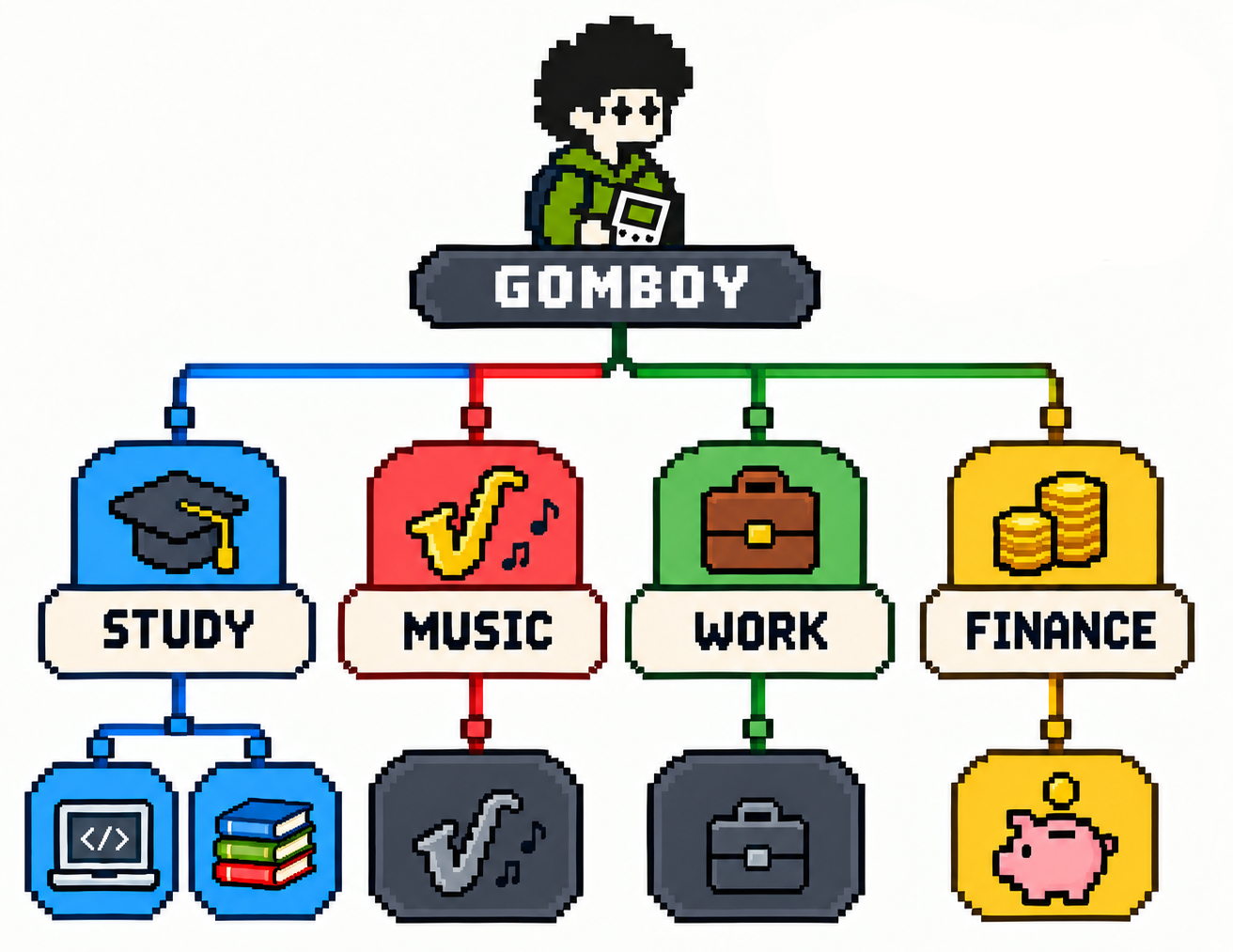
To give it everything I had, I made my first hard choice and put my conservatory studies on hold. Back then, an absurd law stopped you from attending both at once, unless you agreed on a maximum total number of exams. I was willing to bend over backwards, but fewer exams per year meant more years to finish.
Then I cut the processions too. They took up too much time, and in the summer I needed that time to study and sit my exams. It was no small sacrifice, because those were the days that, back in level 1, brought in about a thousand euros a season. A small leap into the unknown.
Luckily, the saxophone turned out to be a real cash machine. Thanks to my brother, I joined a five-piece band that played events all over Italy. Sometimes it felt surreal to play for an hour and pocket €100. The pay was higher on average, the gigs were far less frequent and spread throughout the year. That meant I could study more without giving up music altogether.
The saxophone I’d bought in high school was paying off.
The Right Branch
In my first year, university became the center of my world. I attended lectures I loved, taught by very capable professors, and spent almost the whole day within those walls. Maybe what I liked most was the idea that some subjects could be studied in an almost infinite level of detail. That’s exactly how it works in the world of computing. You can always go deeper, and you’ll always find something else down there.
This reignited my urge to explore and find my own field. I could no longer limit myself to HTML, CSS and JavaScript, the languages used to build websites. I also let go of the idea of the company, because I felt I still had far too much left to discover. Jerry Maguire carried the mission on alone, and our paths split.
And the income I’d had as a teenager? I found new ways to earn at university too.
Getting Paid to Study
The first way was scholarships. Depending on your financial situation and the requirements set out in the call for applications, you can get financial support in Italy to study. In my case, that option was open to me too.
To get the scholarship, you had to reach a minimum number of credits, the CFU, which are the points each exam awards. With my first-year exams I unlocked it, and every year I hit the threshold, almost €2,000 landed directly in my account.
You can see it clearly in my finances. At the start of 2019, 2020 and 2021, almost €2,000 extra shows up, right on schedule.
The Only Tech Person at the Company
From my second year on, I wanted to get some real experience, so I accepted my first part-time job as an employee. It was a company that resold food products online, and my task was to bring sales to their website. In practice, though, I ended up doing a bit of everything: graphics for the catalogs, edits to listings on Amazon and eBay, technical problems with the management software, social media pages and sponsored campaigns. Being the only real tech person there, I was a one-man army.
It was the typical Italian family-run business. Six employees in a space of just a few square meters. Almost every day something funny happened, and even in the most desperate moments, the place itself kept things light.
The initial contract lasted three months, for about €350 net per month and around 6 hours a week. For them, it was a gamble, an attempt to get the website going again. I believed in it from day one and, after three months, the site was generating hundreds of euros in sales a month.
For people with well-established Amazon and eBay shops that isn’t much, but on the website the margins were higher, since there were no platform fees to pay. So we decided to keep going for about a year. By the end of that period, the site’s sales had reached thousands of euros a month.
Experiment successful. At that point I quit to focus on my third-year exams. My first resignation.
It’s hard to make an employer see what you’re worth until you walk out the door.
With me, the company had broad and well-established tech coverage. To fill my role, they had to spread the tasks across several people. A graphic designer took care of the occasional jobs, someone followed the content, the website and the social channels, and the warehouse guy handled the Amazon and eBay edits when needed.
The website was the real problem. The person in charge, a freelancer who managed social media pages, didn’t have the technical skills required. It didn’t take long for things to go downhill. Even a seemingly trivial change, like swapping a banner on the home page, turned into a problem. The site stopped working properly and performance collapsed.
After just a few months, the owner called me back, desperate. I was buried in exams, so I handed the project over to my brother, who carried it forward very well, with a further increase in sales.
One Project, Multiple Clients
In the meantime, I had plugged the hole in my income in a slightly more creative way. Some fellow students commissioned small software projects from me, often tied to the topics we were studying at university.
I already had experience with that kind of work and could start from a base I knew well, adapting it each time to the specific requirements. They weren’t big jobs, but the ratio between the time needed and what I earned was attractive. I made between €50 and €150 per project, with practically zero costs.
A few hours were enough to develop the requested changes, prepare everything and deliver it. It was another way to turn the skills I was acquiring into small streams of income, without giving up the time I needed for my exams.
The First Safety Net (and a €2,000 Game Over)
My finances were slowly growing. In those years I started getting familiar with a concept that didn’t exist in high school: setting money aside as a safety net for future expenses and unexpected events. What’s known as an emergency fund.
Between scholarships, part-time jobs and projects, income was coming from different sources. Much of it was occasional and ended up in everyday spending. I wasn’t following a real savings strategy and I had no specific target to reach. I just knew that this money could be needed at any moment for something more important.

So I built it up little by little, up to a peak of just over five thousand euros.
Compared to the €300 of level 1, quite a jump. And the safety net was put to the test almost immediately.
For my first two years of university I’d been using an old computer. I’d put up for a long time with its slowness and its problems, until one day, while I was working on a project, it froze and wiped out everything I’d done. Hours of work, gone. The classic video game Game Over.
I shut the PC down and decided never to turn it on again. Right after that, I opened the Microsoft website and configured a new Surface.
€2,000. I had never spent a sum like that. I didn’t have to postpone the purchase or look for a makeshift fix, because I had money set aside and I used it.
It was an impulsive decision and, with a more considered purchase, I probably would have spent less. But, like the saxophone, it was an expense made to work, not just to consume. It has paid for itself over many years of projects, and I’m still using it now to write these articles.
An emergency fund isn't there to make your money grow. It's there so you don't have to make decisions under pressure.
An emergency fund is a sum set aside to handle the unexpected without derailing the rest of your plans. It can cover a broken computer, a medical expense or a period without income. Its priority isn't to generate returns, but to be available when you need it. That's why it should stay easily accessible and not be exposed to risks that could shrink its value at exactly the wrong moment.
How big should it be? As a rule of thumb, people often talk about three to six months of essential expenses. It's not a rule that works for everyone. It depends on how stable your income is and how much room you need to get through a difficult period.
Mine, in those years, came from scholarships and projects I sold, so it was anything but regular. The more irregular your income, the more a safety net comes in handy.
The Final Year
During my last year, two noteworthy things happened. The first was a genuine boss fight.
I went back to the company where I’d worked part-time and negotiated a deal with no in-person hours. My brother and I would take over the management of all their online sales channels. We’d get a much lower base pay than for in-person work, but in exchange a tiny percentage of the net profit on the products sold, meaning what was left after subtracting all operating costs. Less than 2%, depending on the channel.
I think the owner had run a couple of numbers on historical sales volumes and figured he was getting two people for the price of one. For us, it was a challenge. We studied every technique for automating price changes, used tools to spot new products to sell, and spent our weekends monitoring competitors.
Working harder wasn’t enough. We had to find a way to work better, automate whatever could be automated, and figure out where the opportunities were hiding. In three months we pushed the profits to a level the owner no longer considered sustainable, and he asked us to renegotiate the deal. We took what we were owed and turned down the offer.
The second thing, though, would have far more lasting consequences.
Among the elective exams was Agent-Based Systems. That’s where I had my first contact with artificial intelligence. It wasn’t yet a field everyone was talking about, but for me it was love at first sight.
I found myself doing what I knew best. Hunting for books, exploring online resources, studying even when it wasn’t strictly necessary to pass an exam. The deeper I dug into the subject, the more I realized how much there still was to discover.
That subject became the topic of my thesis. I graduated, but something had happened along the way. I had found a field I wanted to explore far beyond the boundaries of the university.
For many people, graduating is the finish line, the conclusion of a path. For me, it was only the starting line.
Checkpoint
Leaving this level, my inventory was decidedly fuller than at level 1.
I had stronger skills in web development, e-commerce management and online marketing. Above all, I had a new passion for artificial intelligence. I had my first real work experience, concrete results to talk about, and a first taste of what it means to negotiate your own value. And I had a power-up I didn’t have in high school: an emergency fund.
I had also left something behind. The conservatory, the processions, the company with Jerry Maguire. Every skill point spent in one direction leaves another branch uncovered.
On the My Save File chart, the Level 2 checkpoint climbs from the €300 of level 1 to just over five thousand euros, then drops back down after the PC purchase. That drop doesn’t mean the emergency fund failed. It means it did its job.
I still didn’t have a real savings plan. Money came in, expenses absorbed it, and whatever was left sat in the account, waiting to be useful. But for the first time, I understood that this money could do more than just pile up. It could give me room to maneuver when things didn’t go as planned.
This level ends here, with a degree in my pocket and a new obsession. I had just glimpsed a world that promised to be far bigger than I’d ever imagined.
In the next chapter, we change maps. See you there.
💬DISCUSSIONS & COMMENTS
COMMENTS CURRENTLY UNAVAILABLE
The comment section is temporarily disabled due to inactivity. It will be restored in upcoming updates!